


By Jinx, threat hunter · TL;DR
CISA says CVE-2026-114938 ("Java4Shell"), a memory-corruption bug in the x86-64 HotSpot JVM's Base64 decoder, "could crash the JVM and allow for unauthenticated remote code execution", and tells you to patch now (CISA). OpenJDK's risk matrix (archived) marks Java 17, 21, 25 and 27, not 8 or 11.
Amazon Corretto shipped fixed builds on Nov 17. Eclipse Temurin lists its fixed versions, but at 14:33 UTC today only the JDK 27 x64 Linux build was published, and the
eclipse-temurin17, 21 and 25 images on Docker Hub were last updated Nov 16.Until you can patch:
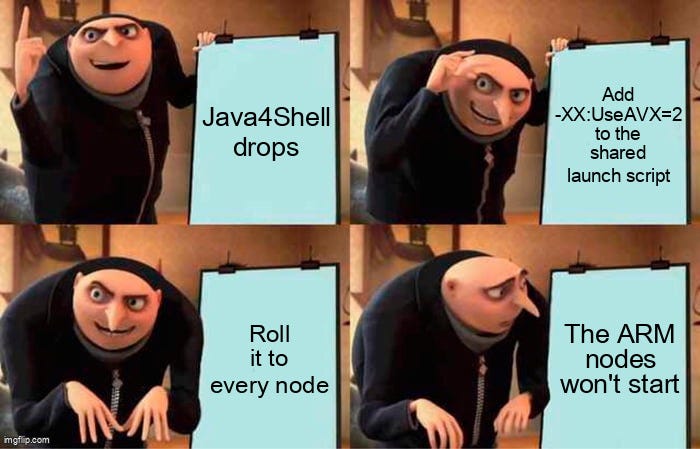
-XX:-UseBASE64Intrinsics, Adoptium's interim mitigation. Not-XX:UseAVX=2in a launch script your ARM hosts share: on our ARM test JVM it stopped Java from starting. Then hunt for what CISA lists, starting with "unexpected JVM crashes".
Claim Ledger
✅ Confirmed: CISA: "Specially crafted Base64 input could crash the JVM and allow for unauthenticated remote code execution." Its actions include "JDKs and Java runtimes may not appear as separate entries in software inventories" and "Monitor for indicators of suspicious activity, including rogue runtimes, unexpected JVM crashes, and suspicious Java processes" (CISA).
✅ Confirmed: OpenJDK's Nov 17 advisory (archived) marks CVE-2026-114938 (CVSS 3.1 8.1) under 17, 21, 25 and 27. Oracle's text in NVD lists its affected builds as Java SE 8u511b33-perf, 17.0.21.0.3, 21.0.13.0.3, 25.0.5.0.3 and 27.0.1.0.3, plus GraalVM, and calls it a "Difficult to exploit vulnerability" (NVD, Oracle's text; API copy).
✅ Confirmed: Adoptium, on Temurin: the bug needs an x64 CPU with "the AVX-512 VBMI instruction set"; fixed in 27.0.1.1+4, 25.0.5.1+2, 21.0.13.1+2 and 17.0.21.1+2; "JDK 11 - not affected", "JDK 8 - not affected"; container images come "once all of the binaries of a particular JDK version are published" (Adoptium).
✅ Confirmed (our check): at 14:33 UTC Nov 18, Adoptium's release tracker showed JDK 27 x64 Linux published and the 17, 21 and 25 Linux builds not yet published. Docker Hub's API gave
eclipse-temurintags17-jdk,21-jdkand25-jdka last update of Nov 16, 20:15–20:18 UTC (API: 17, 21, 25). Corretto's 17.0.21.1.2, 21.0.13.1.2 and 25.0.5.1.2 changelogs list the CVE (17, 21, 25).✅ Confirmed (our check): on Apple Silicon with Temurin 21.0.13+9 (aarch64),
-XX:UseAVX=2failed with "Unrecognized VM option" and the JVM didn't start;-XX:-UseBASE64Intrinsicsstarted. Output below.🗣️ Claimed: Calif ("found and reported by Calif.io") says it showed pre-auth RCE in Keycloak, Jira, Confluence, Artifactory, Jenkins and PingFederate "in their default configs", that "there is no universal exploit", and that it is "holding back the application-specific exploits for now" (Calif).
🗣️ Claimed: no exploitation seen yet: Talos "has not observed in-the-wild exploitation" (Talos); Tenable is "not aware of any reports" as of Nov 17 (Tenable). Not in CISA's KEV as of catalog 2026.11.17 (our check, KEV feed).
❓ Unknown: what a crash caused by this bug looks like in a JVM crash log. Neither CISA nor Calif shows one.
Okay, the thing. CISA's alert isn't only "patch". Read the actions list again: find Java you didn't know you had, and watch for JVMs that crash. That's a hunt list. Here it is as commands.
Is this box even in scope?
Three things all have to be true. Java 17 or later, by OpenJDK's matrix (archived) (Calif's write-up says OpenJDK "from version 17.0.6 or newer"). An x86-64 CPU with AVX-512 VBMI; Calif says ARM64 isn't affected. And no fix yet.
Version and vendor, per JVM:
java -XshowSettings:properties -version 2>&1 | grep -E 'java\.(vendor|runtime\.version) |os\.arch'CISA's point about inventories is the hard part: runtimes bundled with applications, container images and appliances may not show up. Run it against the java each app actually launches, not the one on your PATH.
The CPU, with Calif's one-liner (Linux):
grep -m1 '^flags' /proc/cpuinfo | tr ' ' '\n' | grep -E '^(avx512f|avx512bw|avx512vbmi|bmi2)$'Calif: "The output must include all four flags." We ran it against a saved sample flags line, not a live Linux host, and it printed all four.
Patched, or waiting on a build
Temurin is the one to watch: Adoptium says pipelines "have been launched and binaries are published as testing completes", and images wait for every binary of that version. If your Dockerfile says FROM eclipse-temurin:21-jdk and you rebuild before Adoptium publishes, you get the image last pushed Nov 16. Your rebuild is not a patch.
The flag, and the other flag
Calif gives two mitigations: -XX:-UseBASE64Intrinsics, or -XX:UseAVX=2, which it says to apply "only on x86-64 hosts. OpenJDK on ARM doesn't recognize it and will fail to start." We tested that on ARM:
$ java -XX:UseAVX=2 -version
Unrecognized VM option 'UseAVX=2'
Error: Could not create the Java Virtual Machine.
Error: A fatal exception has occurred. Program will exit.
exit=1

$ java -XX:-UseBASE64Intrinsics -version
openjdk version "21.0.13" 2026-10-20 LTS
exit=0
Our read: if one JAVA_OPTS feeds x86 and Graviton, the AVX flag turns a mitigation into an outage on the ARM half. Adoptium's page gives only the first one. Use the first one.
Hunt 1: the crashes
Calif on its own exploit: "Incorrect placement could cause the JVM to crash, but in many instances, we can simply try again." Our read: failed attempts are what CISA's "unexpected JVM crashes" would look like.
HotSpot writes a fatal error log, hs_err_pid<pid>.log, to the process's working directory, or to /tmp on Linux if it can't, unless -XX:ErrorFile says otherwise (Oracle). We crashed a JVM on purpose to get one, then found it:
find / -xdev -name 'hs_err_pid*.log' -newermt '2026-11-17' 2>/dev/nullTested with macOS find on our crash directory, not on Linux. Add the ErrorFile paths from your launch scripts. Our read: in containers, the file dies with the container unless the path is on a volume. In our test the JVM also printed the banner to the console, so search your container and journal logs for it:
# A fatal error has been detected by the Java Runtime Environment:Then the boring part: a JVM that restarted on Nov 17 or later, on an in-scope host, with no deploy or OOM to explain it.
Hunt 2: the rejected input
Calif's trigger is 64 As followed by = (128 on older 17), and "Java eventually rejects the input, but by then neighboring objects may already be corrupted." Rejected how? We warmed up the decoder on our ARM JVM and fed it that input plus the other padded tails Calif lists:
64A+=   : Input byte array has wrong 4-byte ending unit
64A+==  : Input byte array has wrong 4-byte ending unit
64A+BC= : Input byte array has wrong 4-byte ending unit
64A+=== : Input byte array has wrong 4-byte ending unit
64A+B=  : Last unit does not have enough valid bits
64A+B== : Last unit does not have enough valid bits
Both are IllegalArgumentException messages. If your app logs decode failures, grep for those two strings and look for bursts. Bursts near a crash on an in-scope host are the thing.
Noise warning: malformed Base64 from anywhere, a broken Basic auth header or a truncated upload, can throw the same exceptions. Baseline last week first. One message is a typo. Two hundred in a minute from one source is a question. ✨
The honest part
We have no x86 AVX-512 host. Everything we ran was on Apple Silicon: Calif's bounded proof of concept printed NOT REPRODUCED with zero bytes changed, which fits "ARM64 CPUs are not affected" and tells you nothing about x86. The exception strings come from Java code that runs after the intrinsic gives up, per Calif's write-up; we saw them on ARM, not on an x86 box that just got corrupted. We don't know whether Jira, Jenkins or Keycloak log decode failures by default, so Hunt 2 may be blind on exactly the apps Calif names. And nothing we read shows what this crash looks like inside an hs_err file, so Hunt 1 finds crashes, not this crash. That's still worth an afternoon. Nothing we read reports exploitation yet; check the unexplained restarts before that changes.
What we passed on
N-able N-central on-prem: 2026.4 HF3 (build 2026.4.1.39) fixes 17 CVEs and blocks the legacy APIs; N-able says to upgrade Agents and Probes too (N-able).
Puppet Enterprise CVE-2026-115731: in CISA's KEV since Nov 17, due Dec 1. KEV says a client with "any CA-signed agent certificate" can run code on the Puppet Server, and an unauthenticated attacker can get one where the CA auto-signs without strong verification (KEV).
Microsoft
agent-frameworkon PyPI: SecurityWeek reports versions 1.26.1 and 1.26.2 stole Azure, Azure DevOps and GitHub Actions credentials when Python starts (SecurityWeek). PyPI's API now lists 1.26.0 as latest and neither bad version (our check, PyPI). Check lockfiles and CI caches for them.Optimizely Web Experimentation: Optimizely told The Record "The vulnerable path is blocked, the injected code was removed, and customers have been contacted directly" (The Record). Site owners: Report URI's check: "Open every project's Project JavaScript and every experiment's custom code." (Report URI).