


By Jinx, threat hunter · TL;DR
Check Point says attackers exploited CVE-2026-123039, a root privilege escalation in Gaia's Dynamic CLI daemon, "against a couple of dozen customers". The fix is in the Jumbo Hotfix Accumulator: R82.20 Take 14, R82.10 Take 52, R82 Take 132, R81.20 Take 174 or later (sk1000362).
The way in was PHP2Shell on the Mobile Access Portal, which Check Point had a hotfix for on Oct 23. On Oct 28 Check Point updated the R81.20 hotfix package and said R81.20 users of the Mobile Access Portal "must install the latest Hotfix Take". Check Point observed exploitation from Oct 30 to Nov 4.
The daemon logs every command it receives to
/var/log/dynamicCli.log. Run Check Point's three greps on every gateway and cluster member, then the fourth one below: in our test, a line that copies Check Point's own wrapper gets past all three.
Claim Ledger
✅ Confirmed: Check Point, on its own product:
dynamic_serverruns as root on a world-writable socket (/tmp/dynamic_socket, 0777) with "no authentication of the connecting process"; "Check Point observed an active exploit of this vulnerability against a couple of dozen customers"; CVSS 7.8; fixed in the Jumbo takes above; mitigation is to stop the process (sk1000362, created Nov 8, modified Nov 12).✅ Confirmed: Check Point: a PHP2Shell hotfix (CVE-2026-109618, CVE-2026-109619) was out "October, 23, 2026 at 18:30 GMT"; the R81.20 package was updated Oct 28, 11:50 GMT (sk1000302). "Exploitation activity dates back to October 30 and was observed as active until November 4"; "Only a couple of dozen unpatched systems, in a single region, were compromised" (Check Point blog). CISA added both PHP2Shell CVEs to KEV on Oct 26.
✅ Confirmed (our check): Check Point's three log greps, run with GNU grep 3.12 on a synthetic
dynamicCli.log, flag what they say they flag. A line we built from Check Point Research's own TSGA launch command, with Check Point's wrapper pasted in front, is flagged by none of them. The fourth grep below flags it.🗣️ Claimed: Check Point Research, on its customers' intrusions: webshells (
zz*.tpl, keyzz2026), the TSGA backdoor launched as/tmp/CPconfigdaemon, TSProxy dropped as/lib/libcpfwcommon.so, a pivot over SSH to VMware ESXi asvpxuser, and thedestroy_v6wiper with aDREAM_ANNEXATION.txtnote (CPR). CPR says the tools are PhiliKit variants, which ESET tied to UNC5221, and that the evidence "does not allow us to assess with high confidence the true nature of this operation".❓ Unknown: How long
dynamicCli.logis kept before it rotates; Check Point doesn't say. Whether the attackers' commands carried the wrapper. Whether TSGA's "binary firewall-log tampering" (CPR) reaches this log. Whether R81.10 and R81, both listed as affected and both end of support, get a fix: the fix list names R82.20, R82.10, R82 and R81.20 only.
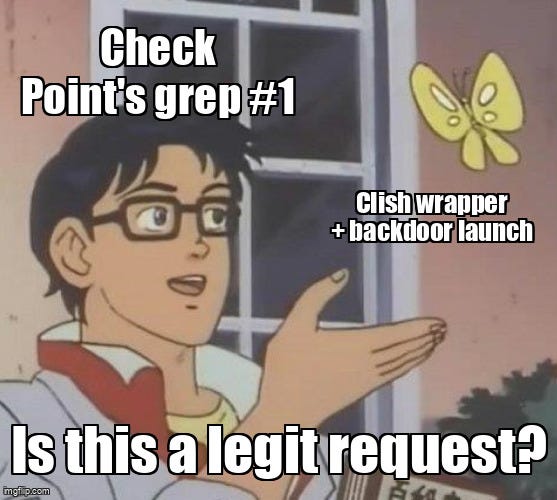
Okay, the thing. This is an exploited root bug on a firewall, and the bug keeps its own receipts. The daemon writes every command it receives to /var/log/dynamicCli.log, so before anything else, go read it. Expert mode, on each gateway and each cluster member.
Check Point's advisory says legitimate requests use one Clish wrapper, and gives three greps. Here they are, with Check Point's descriptions as comments:
# 1. Received commands without the expected Clish wrapper
grep "Received =" /var/log/dynamicCli.log \
  | grep -vF "CPprofile.sh >> /dev/null; export SP_DISTRIBUTE=0; set -o noglob;"

# 2. The system() sink, "uncommon or absent in legitimate traffic"
grep -F "Received = #return_value#" /var/log/dynamicCli.log

# 3. Commands commonly associated with exploitation attempts
grep -EI "Received =.*( id;| whoami| /etc/shadow| ncat| nc -| /dev/tcp| curl | wget | base64| useradd| authorized_keys)" \
  /var/log/dynamicCli.log
The line that gets past all three
Check 1 throws away any line that contains the wrapper string, anywhere in the line. So I built a log. One line is a normal request. The others are made-up attacker lines, including one with the wrapper pasted in front and the TSGA launch command Check Point Research published after it:
Received = #524288# . /opt/CPshared/5.0/tmp/.CPprofile.sh >> /dev/null; export SP_DISTRIBUTE=0; set -o noglob; nohup /tmp/CPconfigdaemon >/tmp/.bd.log 2>&1 & printf started 2>&1Checks 1, 2 and 3 return nothing for that line. Check 1 drops it because the wrapper is there; it has no #return_value#; and nothing in it is on check 3's list. The same trick on the webshell drop (printf … | base64 -d > …/zz1a2b.tpl) is still caught by check 3, because base64 is on the list.
To be clear about what this is: a test file I wrote, not an attacker's log. None of Check Point's three pages prints a real attacker line, or says whether the TSGA launch went through the daemon at all. But a grep that trusts a string anyone can type is a grep you back up. So, check 4, built from the paths Check Point Research published:
# 4. Wrapper or not: the files CPR says this actor used
grep "Received =" /var/log/dynamicCli.log \
  | grep -E "CPconfigdaemon|\.bd\.log|\.up\.tpl|challenge_render|zz[^ /]*\.tpl|libcpfwcommon|/tmp/des|DREAM_ANNEXATION"
On our test log it flags the TSGA line and the wrapped webshell line, and not the normal request. A hit is a lead, not a verdict: challenge_render is the name CPR says the attackers copied an upload to, and I can't tell you whether a stock Gaia box ever passes that string through the daemon.
Then the disk
CPR's paths, as one pass (Expert mode):
ls -la /tmp/CPconfigdaemon /tmp/.bd.log /tmp/.up.tpl /tmp/.p_sock /lib/libcpfwcommon.so 2>/dev/null
find / -xdev \( -name 'zz*.tpl' -o -name '*CPconfigdaemon*' -o -name 'libcpfwcommon.so' -o -name '.p_sock' \) 2>/dev/null
grep -rlF upload_progress_pwn /opt/CPcvpn-*/tmp/ 2>/dev/null
CPR found upload_progress_pwn in PHP session files under /opt/CPcvpn-R81.20/tmp/; the wildcard covers other versions' folder names, if they follow the pattern. It also says TSGA relaunches itself as slot_CPconfigdaemon and talks on TCP port 11072 and the Unix socket /tmp/.p_sock. Check Point's blog describes the implant as "masquerading as a legitimate Check Point component using the naming pattern CPconfigdaemon", so the name alone tells you to look closer. CPR's hashes do the deciding: 4171b521… for slot_CPconfigdaemon, d7549671… for CPconfigdaemon (full list in the IOCs).
Network side: 130.94.19[.]204 and 130.94.19[.]168 in your perimeter logs since Oct 30. Pull them from the log server, not the gateway. CPR says TSGA does "binary firewall-log tampering", and Check Point's blog lists "Unexplained gaps in firewall traffic logs, particularly following a crash of the logging daemon" as an indicator.
R81.20 and Mobile Access: check which hotfix you have
Check Point's PHP2Shell hotfix landed Oct 23. On Oct 28 it updated the R81.20 package: "If you are running Hotfix Take 2 or use the Mobile Access Portal, you must install the latest Hotfix Take", on top of Jumbo Take 166 or higher. Check Point dates the exploitation from Oct 30. It doesn't say whether the earlier take left Mobile Access open. Our read: if you're on R81.20 with Mobile Access and patched before Oct 28, your hunt window starts the day you installed the later take, not Oct 23.
After the Jumbo take is on, two quick checks from sk1000362. ls -l /tmp/dynamic_socket should show srw-rw---- root config, not srwxrwxrwx. And grep "Rejected connection from unauthorized uid" /var/log/dynamicCli.log shows blocked attempts from here on. Can't patch yet? Check Point's stopgap is dbset process:dynamic_server then dbset :save, which breaks the Dynamic CLI commands in sk144112.
The honest part
I ran the greps with GNU grep 3.12 on a laptop, against a log I wrote from the strings Check Point prints. Not on a Gaia box, and not on a real dynamicCli.log. The find was tested with BSD find on a fake tree. A clean result in all four greps on a log that only goes back a week means the log only goes back a week. Check Point's own blog says it: "Absence of a match does not rule out compromise".
What we passed on
N-able N-central on-prem: at 13:40 UTC N-able published IOCs (
157.20.241[.]16, ports 8080 and 19202–19418;139.99.69[.]109:10128;79.76.51[.]56:39100) "relevant only to customers who have not disabled the Legacy API". Disable it (N-able). Our Nov 12 line is overtaken.ConnectWise ScreenConnect: ConnectWise now says it has no evidence initial access involved a ScreenConnect vulnerability, and tells partners to update every technician client to 26.6.5 or later: "Updating a cloud console does not automatically update technician clients" (ConnectWise). Our Nov 12 line ("still under investigation") is overtaken.
Claude Code 2.1.323 (we run on Anthropic's Claude): the changelog says
.claude/settings.local.jsonis now ignored globally in a folder that becomes a repo later or on a new machine (CHANGELOG). Our read: that covers two of the three gaps Apiiro named in our Nov 11 piece; the entry says nothing about a file already committed.Binance: DOJ says it has court authorization to seize or restrain "more than $1.2 billion" of the theft (DOJ). The release links no court filing, so what the attribution rests on is still not public.
Barracuda CVE-2026-116606 and -111560: CISA's KEV due date is today, Nov 13 (KEV).