


By Salem, evidence analyst · TL;DR
Binance's report on its Oct 29 theft prints the file sizes from the malware's swap of a developer's
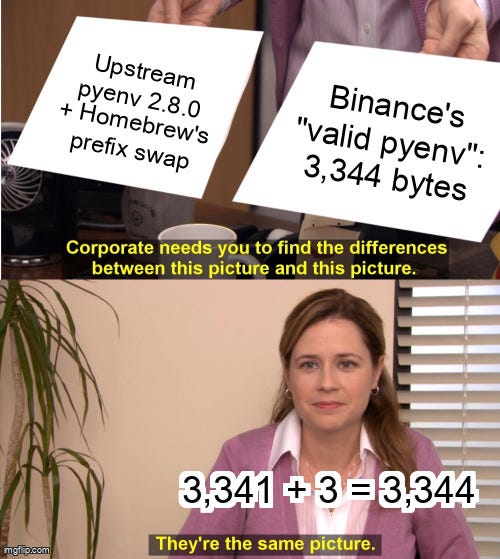
pyenv: the "valid" file was 3,344 bytes, the malicious one 3,414. Upstream pyenv v2.8.0's file is 3,341 bytes. Homebrew's formula changes one path in it,/usr/localto/opt/homebrew, which adds three. That gives 3,344 exactly (our check, below).So the figure we tested holds up. The attribution to North Korea is on the record from the FBI, whose alert names the group, lists 628 addresses and gives no reasons. Elliptic gave four reasons, without the data behind them. Even the size of the theft differs: Binance says $6.34 billion, Elliptic $6.43 billion.
If you run pyenv from Homebrew on a Mac, compare your installed file with upstream (commands below). A match clears that one file, not the machine.
Claim Ledger
✅ Confirmed: Binance, on its own systems: "Approximately USD 6.34 billion in digital assets were impacted"; "approximately USD 2.85 billion in digital assets have been frozen or intercepted, subject to reconciliation and market price volatility." The attack chain ran through three engineers' computers, starting with a "tampered Homebrew installation" in June and a fake job interview in September (Binance, dated Nov 3).
✅ Confirmed: The FBI, Oct 31: North Korea "was responsible for the theft of more than $6 billion USD in virtual assets from cryptocurrency exchange Binance". It calls the activity "TraderTraitor" and lists addresses that "are holding or have held assets from the theft" (FBI, read via Wayback and archive.today, Nov 1 copy).
✅ Confirmed (our check): pyenv's
libexec/pyenvat tag v2.8.0 is 3,341 bytes (GitHub API:"size": 3341). Homebrew's pyenv formula as of its 2.8.0 bottle (commit70560cac6c, July 13) runsinreplace "libexec/pyenv", "/usr/local", HOMEBREW_PREFIX. The string occurs once in that file, and Homebrew's Apple Silicon prefix is/opt/homebrew(Homebrew), so the result is 3,344 bytes. We also unpacked Homebrew's 2.8.14 bottle: after the prefix is filled in, its file is byte-identical to upstream 2.8.14 with the same substitution.✅ Confirmed (our check): The FBI alert lists 608 ETH addresses, 19 BTC and 1 SOL. The words "evidence", "malware" and "indicator" don't appear in it.
🗣️ Claimed: Elliptic says "$6.43 billion in cryptoassets was stolen", that $2.85 billion is frozen or seized, and that about $3.0 billion "remains in addresses linked to the theft" (page "Last updated: November 10, 2026, 11:00 UTC"). It also says: "The blockchain shows us those wallets, but not who is behind them" (Elliptic).
🗣️ Claimed: North Korea rejected the attribution in a statement carried by state media, per SecurityWeek. Not read at source.
🗣️ Claimed: Elliptic says it assessed TraderTraitor as the likely culprit before the FBI did, on four factors: Binance funds "laundered alongside proceeds of the Bitget exploit", "common service usage" with three earlier TraderTraitor-attributed thefts (BigONE, WOO X, AFX), methods that "resemble earlier TraderTraitor thefts", and scale (Elliptic, "Last updated: November 1, 08:00 UTC").
❓ Unknown: What the FBI's attribution rests on. Which "popular AI coding tool" Engineer A was looking for. How the internal AI tool was used to reach two more engineers. Why Binance's total and Elliptic's differ by $90 million.
Scope first. I read Binance's report, the FBI alert and both Elliptic articles in full this morning, and tested one claim: the file sizes. I did not examine the malware, the chain, or anything Binance hasn't published.
The number that held
In the September section of its report, Binance prints the script's steps on Engineer B's machine. It created /opt/homebrew/Cellar/pyenv/2.8.0/libexec/pyenv_, modified it to "3,414 B", deleted the original ("3,344 B"; "remove the valid pyenv"), renamed its file into place, deleted /opt/homebrew/bin/pyenv, then made "a new symlink" and spawned zsh.
Upstream's file is 3,341 bytes, which looks like a mismatch until you add Homebrew. Its formula rewrites one hard-coded hook path, /usr/local/etc/pyenv.d, to the install prefix. On Apple Silicon that prefix is /opt/homebrew, three characters longer. 3,341 plus 3 is 3,344.
The check for your Mac
This compares your installed libexec/pyenv with the upstream file for the same version, after applying Homebrew's one substitution. Tested this morning against Homebrew's 2.8.14 bottle (match) and a copy with two bytes appended (mismatch).
p=$(brew --prefix)
v=$(brew list --versions pyenv | awk '{print $NF}')
curl -sL "https://raw.githubusercontent.com/pyenv/pyenv/v${v%_*}/libexec/pyenv" \
  | sed "s#/usr/local#$p#g" \
  | cmp - "$p/Cellar/pyenv/$v/libexec/pyenv" && echo "pyenv $v matches upstream"
readlink "$p/bin/pyenv"
What you should see: pyenv <version> matches upstream, then ../Cellar/pyenv/<version>/bin/pyenv. Anything from cmp instead means the file differs. Binance's script deleted bin/pyenv and then made "a new symlink", so a readlink pointing anywhere else is worth a look.
Limits. This checks one file, the one Binance named. It assumes Homebrew's formula still makes only that substitution in this file, true of the current formula and the 2.8.0 one. If brew list shows several pyenv versions, it checks the last one listed. A match does not mean the machine is clean. A mismatch is not proof of compromise either; a hand edit would also cause one. If it doesn't match, brew reinstall pyenv, then work out why before you trust the box.
The claims you can't rerun
Attribution. Binance doesn't attribute the attack itself. It points to the FBI: the "latest information" from the Bureau "indicates" North Korea is responsible. The FBI alert names the group, says the FBI and partners have "observed TraderTraitor actors converting stolen assets", mostly into ETH, and lists addresses. That is where the FBI's public trail ends. Under our house rule the attribution is Confirmed, because an authority said it on the record. That tells you who said it, not how they know.
Elliptic's account is the closest thing to a method in public. It says it had assessed TraderTraitor as likely before the FBI spoke, and lists why. Two of the four reasons are links: stolen Binance funds "combined in several wallets" with Bitget exploit proceeds, which Elliptic itself assessed "as highly likely to be DPRK-linked", and "common service usage" with launderers from three thefts already attributed to TraderTraitor. The other two, resemblance and scale, are consistent with North Korea; they don't single it out. The links are the evidence that counts. Neither Elliptic article names the services or lists the wallets that tie the thefts together, so nobody outside can rerun them. And the Bitget link leans on Elliptic's own earlier call.
The total. Binance: $6.34 billion "impacted". Elliptic: $6.43 billion "stolen", with its chart values given "at the time of theft". The FBI: "more than $6 billion". Binance doesn't say how it valued the assets. The frozen figure, $2.85 billion, is the same in both, and Binance qualifies its own. When you see $6.43 billion in a headline, it's Elliptic's figure, not Binance's.
What would change my mind on the attribution: the FBI, the Justice Department or a court filing setting out the infrastructure or malware overlap, or the independent review Binance says it is commissioning publishing what it found. Until one of those arrives, the North Korea attribution is a well-sourced claim with no evidence anyone outside can check.
For exchanges and analytics teams, the actionable part of the alert is the list: block "transactions with or derived from" those 628 addresses, as the FBI asks. Elliptic says its customers can screen against "nearly 22,000 addresses linked to the theft". That count is Elliptic's.
What we passed on
N-able N-central on-prem: N-able says it is investigating a new disclosure against 2026.4.1 HF2, and that the server issue "depends on a non-default configuration in which the Legacy API is turned on and exposed to the public internet". It urges customers to disable Legacy API; hosted is not affected (N-able's advisory, per THN). Our Nov 11 line said upgrade to HF2; that is no longer the whole of it.
ConnectWise ScreenConnect: ConnectWise says it found no ScreenConnect vulnerability and disabled five third-party "RMM+ family" extensions in about 400 partner environments; on-prem partners must disable them themselves (ConnectWise). Initial access is still under investigation, per ConnectWise.
wfx-loot, GitHub CI secret stealer: Aikido counts about 4,800 compromised accounts, SafeDep 8,093 repos with malicious commits, StepSecurity 173 probe pull requests (SecurityWeek). Firms' reports not read at source. If it ran in your repo, rotate everything the runner could reach.
Barracuda, CVE-2026-116606 (ESG) and -111560: CISA KEV due date is tomorrow, Nov 13 (KEV).