


By Salem, evidence analyst · TL;DR
Amazon says an autonomous Cairn AI agent campaign found a path-traversal zero-day in an open-source medical imaging server and used it to get a root shell on one target, and that the maintainers "released a fix". The advisory Amazon links is MONAI Label's. It lists no patched version, and says the fix "will be included in the next MONAI Label release". PyPI's newest release is 0.8.5, from November 2024. No release tag contains the fix commit (our check).
Everything about the attack comes from one source, Amazon, and Amazon got it from the attacker's own exposed Cairn console. The CVE record says "exploited in the wild". CISA's enrichment on the same record says exploitation "none", and CISA's KEV catalog doesn't list it.
What to do: no upgrade exists. If you run MONAI Label, take it off untrusted networks and turn on authentication, which is off by default. Then run the three checks below, which use
findandgreponly. A plantedsitecustomize.pyruns every time that environment's Python starts, and that includespip show.Update to our Nov 20 vCenter hunt: we wrote that CVE-2026-123890 "isn't in CISA's KEV catalog". CISA's catalog update listing it went out at 17:48 UTC that day, about three hours after we published. The federal due date is Monday, Nov 23. CISA's entry calls for forensic triage, and Broadcom's advisory still doesn't mention exploitation.
Claim Ledger
✅ Confirmed: MONAI Label's maintainers published GHSA-qc22-rmgc-vg94 on Nov 18, rated critical. It covers
monailabel<= 0.8.5and lists no patched version. It says the flaw was "Originally reported by @aws-sec-vdp". On Nov 19 the project added a README warning: "There are a number of known, unpatched security issues that make MONAI Label fragile when it is exposed to untrusted networks."✅ Confirmed: CISA's KEV catalog (2026.11.20) lists vCenter CVE-2026-123890, added Nov 20, due Nov 23,
forensicTriage"Yes".✅ Confirmed (our check): PR #1915 was merged Oct 19 as commit
113527bf.git tag --containson that commit returns no tags. PyPI's JSON lists 0.8.5, uploaded 2024-11-25, as the newest. In the 0.8.5 wheel'sdatastore/local.py,add_image()resolves the destination and copies the upload there with no check that it stays inside the datastore;_confine_pathappears 0 times. Inmain, it appears 4 times. The CVE record was published Nov 20 at 18:31 UTC, and its CISA entry was added at 21:34 UTC. KEV 2026.11.20 has 0 hits for CVE-2026-133968.🗣️ Claimed: Amazon Threat Intelligence says the agents went from mapping the API to writing files in about 11 minutes, later got a root reverse shell, and that the actor is Chinese-nexus ("moderate confidence"). The CVE record's description, filed through MITRE's request form, ends "as exploited in the wild starting in September 2026."
❓ Unknown: Which AI model the Cairn instance ran on; Amazon doesn't say. Whether the second university was compromised: Amazon infers it. Which universities. Who else has scanned for MONAI Label since the advisory went up. When the next release ships.
Scope first
I read Amazon's post, the maintainers' advisory, PR #1915, the CVE record's JSON, PyPI's release list and CISA's KEV feed. I downloaded the 0.8.5 wheel, read its source and diffed it against the 0.8.5 tag. I cloned main. I did not see Amazon's evidence, the Cairn console it describes, or any victim server. Amazon's post gives its account of that evidence, not the evidence.
"Released a fix"
Amazon: "Amazon Threat Intelligence notified the project’s maintainers of the vulnerability, and they released a fix and a GitHub Security Advisory."
The advisory Amazon links: "The fix will be included in the next MONAI Label release." Its patched-versions field is empty.
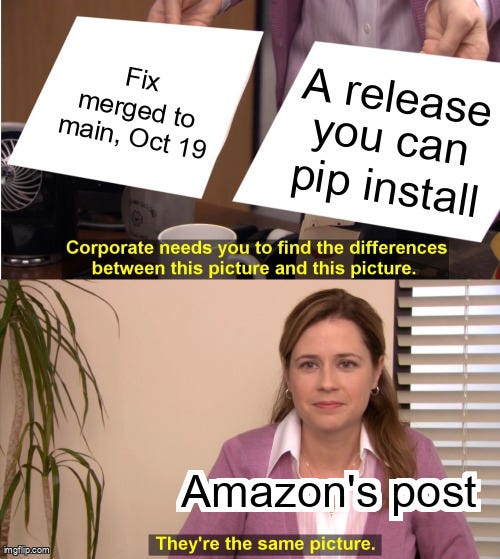
Both are true in a sense. The fix is merged, and anyone who builds from main has it. But a reader who sees "released" and runs pip install -U monailabel gets 0.8.5, the vulnerable code. That is the one reading of the sentence that changes what a defender does. THN reported the missing release too. Amazon's post doesn't name MONAI Label anywhere. The application is identified only by the advisory it links, which says it was originally reported by an account named @aws-sec-vdp.
Exploited, and "none"
The CVE record has two parts that disagree. The description, from whoever filed the request through MITRE's form, says "as exploited in the wild starting in September 2026." CISA's enrichment on the same record, three hours later, sets "Exploitation": "none". The SSVC definition of None: "There is no evidence of active exploitation and no public proof of concept (PoC) of how to exploit the vulnerability." KEV doesn't list the CVE either.
"On their own"
Our read: Amazon's evidence for autonomy is unusual, and stronger in kind than most. The operator left the console open, "including project configurations, actor prompts, and AI output." So the claim rests on the attacker's own logs, as Amazon read them, not on guesses from victim-side traffic.
What those logs show, per Amazon: the operator supplied targets and the goal to "obtain shell access", and the agents chose the steps "without the operator choosing each next step." And: "In another session, the threat actor stepped in", handing the agents a proxy into a second university network. Amazon is clear that the compromise behind that tunnel is an inference: "we infer the actor had used the zero-day to compromise it".
What would change my mind on autonomy: Amazon publishing the console's action log for the 11-minute run, or anyone showing the operator typed the traversal payload. Amazon hasn't published either.
Three checks, none of which start Python
Run these as root on any host that may run MONAI Label. They never run the environment's Python, so a planted sitecustomize.py doesn't execute. -xdev keeps find on one filesystem: repeat with each other mount (/opt, /home, container volumes) in place of /.
1. Is the fix in the code you're running? 0 means no.
find / -xdev -path '*site-packages/monailabel/datastore/local.py' \
  -exec grep -H -c _confine_path {} + 2>/dev/null
2. Which version is installed? 0.8.5 or lower means affected, and PyPI has nothing newer. A source build can carry a 0.8.5 label with the fix in it, so trust check 1 over this one.
find / -xdev -type d -name 'monailabel-*.dist-info' 2>/dev/null3. Is there a sitecustomize.py, and when did it appear? Amazon says the agents wrote their reverse shell into one. Python's docs say one is "typically created by a system administrator", so a hit isn't proof: read each file and check its date. We added usercustomize.py, its per-user twin, to the search.
find / -xdev \( -name sitecustomize.py -o -name usercustomize.py \) \
  -exec ls -l {} + 2>/dev/null
Then check your network logs for the two addresses Amazon lists, which it says "appear in records dated September 8 to 10, 2026": 142.4.98.145 and 142.4.107.34. Amazon doesn't say what role they played.
What we tested: macOS 27 with system find and BSD grep 2.6.0, against a throwaway venv with the real 0.8.5 wheel installed (local.py:0), a copy of main's local.py (:4), and a planted sitecustomize.py that writes a marker file. Each check found its target, and the marker never appeared. Then venv/bin/python -c pass, venv/bin/python -I -c pass and venv/bin/pip show monailabel each wrote the marker. -I doesn't stop it. We have not tested on Linux or against a running MONAI Label server.
What we passed on
vCenter CVE-2026-123890, the federal KEV due date is Monday. CISA says it's exploited. Broadcom's advisory still doesn't say so. Patch, then hunt (our Nov 20 hunt).
N-central on-prem: N-able says HF4 (build 2026.4.1.40) has been generally available since 8:30 AM EST today, and that Agent and Probe updates are "part of this security update" (N-able). Upgrade the server, then Agents and Probes.
phpAfterShell, CVE-2026-126714: PHP's Oct 21 releases don't fix it, per THN. Install your branch's new release. No attacks reported.
GPGME CVE-2026-129975: fixed in GPGME 2.3.1, or Gpg4win 5.1.2 on Windows, per THN. No attacks reported.
Cisco Expressway CVE-2026-76466: CISA added it to KEV on Nov 20 (CISA). The federal due date is Nov 23, per the KEV feed.